
Gaffaney Research & Evaluation


I'm Jaclyn (Jackie) Gaffaney, PhD, MAPP, an evaluator and researcher bridging academic and applied work in wellbeing science, positive organizational psychology, and systems change.
I partner with organizations, educational institutions, nonprofits, corrections, and public sector clients to improve programs, build and validate measurement tools, and evaluate impact. Based in Seattle, I work with clients across the U.S. and internationally.
I am the Founder and Principal Consultant of Gaffaney Research & Evaluation. Alongside my consulting practice, I hold academic appointments as a Postdoctoral Researcher at the Royal College of Surgeons in Ireland and a Research & Evaluation Fellow with the Claremont Evaluation Center at Claremont Graduate University.
Current Affiliations
Founder and Principal Consultant of Gaffaney Research & Evaluation
Postdoctoral Researcher at Royal College of Surgeons in Ireland
Research & Evaluation Fellow at Claremont Graduate University
Services Offered
-
Evaluation Services
Want to know if you're having impact? Want to know how to improve your work?
I help clients identify needs and strengths (needs and assets assessments), measure change (pre/post and outcome evaluation), assess quality (process evaluation), and clarify goals (theories of change, logic models). I create measurement plans and help turn data into action, so clients can better understand their work and amplify impact. -

Academic & Applied Research
Want the credibility of academic-level research and publishing? Want help validating an instrument?
I conduct research for both applied and academic purposes. I help clients build and validate instruments, drawing on expertise in scale development and validation. I publish academic journal articles and present at conferences to contribute to my fields. I welcome collaborations with researchers and practitioners interested in co-publishing or co-presenting.
-

Trainings & Program Design
Want to build your team’s capacity in evaluation or wellbeing?
I lead workshops and trainings on topics ranging from introduction to evaluation and logic models to appreciative inquiry and systems-informed wellbeing initiatives, including how to use the Wellbeing Initiative Design & Evaluation Checklist. I also design programs and interventions, and have worked on leadership trainings, employee wellbeing initiatives, adolescent development programs, and social programs.

Research and Evaluation Skills
I offer a range of quantitative and qualitative research and evaluation skills, tailored to each project's questions and context. I often favor mixed methods, which let me triangulate findings or build from one method to the next. When a project calls for expertise beyond my own, I upskill or bring in trusted collaborators.
My skills and specialties include:
-
Mixed methods (quantitative and qualitative), longitudinal, randomized controlled trial, experimental, quasi-experimental, survey & scale development, needs assessment, social network analysis, appreciative inquiry, systematic review, checklist, behaviorally anchored rating scale, focus groups, interviews, observations, document review, archival data, etc.
-
Regression, ANOVA, factor analysis, growth curve modeling, multilevel modeling, structural equation modeling, path analysis, thematic analysis, grounded theory, etc.
-
Report creation, hosting data shares or data walks across stakeholders, using design thinking to brainstorm how to translate findings into actionable next steps.
-
Put simply, research is designed to answer generalizable questions that contribute to science. Evaluation is designed to answer specific questions that inform decisions about a particular program or initiative. Some engagements straddle the two.
Education
PhD in positive organizational psychology with a co-concentration in research methods & evaluation from Claremont Graduate University.
Master's in applied positive psychology (MAPP) from the University of Pennsylvania.
Bachelor’s in communication with a minor in communication design from the University of Southern California.
Publications & Previous Work
Google Scholar for a list of publications.
LinkedIn to see examples of previous work across applied and academic spaces.
Introducing the Wellbeing Initiative Design & Evaluation Checklist
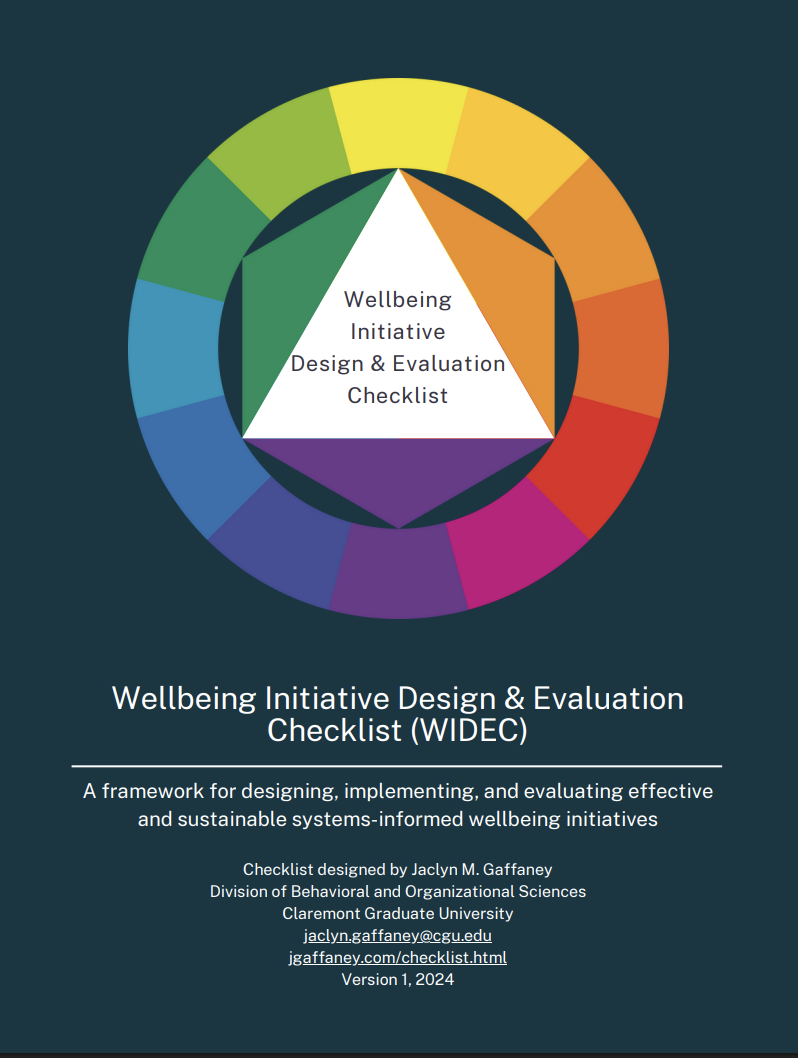
I have created a practical, evidence-informed Checklist to help provide structure and guide people through the complex process of designing, implementing, and evaluating, systems-informed wellbeing initiatives.


Core Principles
Contextually and Culturally Responsive: I tailor my work to the context, culture, and people involved. I strive to understand and respect cultural differences and to respond to them thoughtfully in how I design, conduct, and share the work.
Collaborative and Participatory: I involve clients, participants, and the communities affected by the work in shaping questions, interpreting findings, and actioning next steps whenever possible. I strive to make participation accessible and inclusive so diverse voices inform the process and decisions that follow.
Evidence-Informed and Iterative: As a social scientist, I approach my work with curiosity and an experimental mindset. I build on existing evidence, test ideas in practice, and use what we learn to refine what comes next.
Wellbeing and Strengths-Based: I bring my expertise in wellbeing science and positive psychology to all of my work. I'm prevention-oriented, look for opportunities rather than only problems, and build on the strengths of people and places.
Bridging the Research-Practice Gap: As someone at the intersection of academia and real-world application, I strive to bridge the research-practice gap, bringing learnings from research to practice and insights from practice to research.
Utilization-Focused: Use is the true measure of success. From the start, I focus on who will use the work and what decisions or actions it should inform. I keep that in view through reporting and follow-through, so findings get put into practice.
Sustainable: I aim for impact that outlasts an engagement, building clients' capacity to keep using and learning from their data over time.
Systems-Informed: People, programs, and organizations are shaped by the systems they're part of, and they shape those systems in return. I look beyond individual-level change to the relationships, structures, and norms around the work, and to where small shifts can create meaningful change.
I approach my work with the following principles and values in mind:
Let’s Connect
Interested in working together for an evaluation, research, or other practitioner services?